
dd
Latest posts
-
-
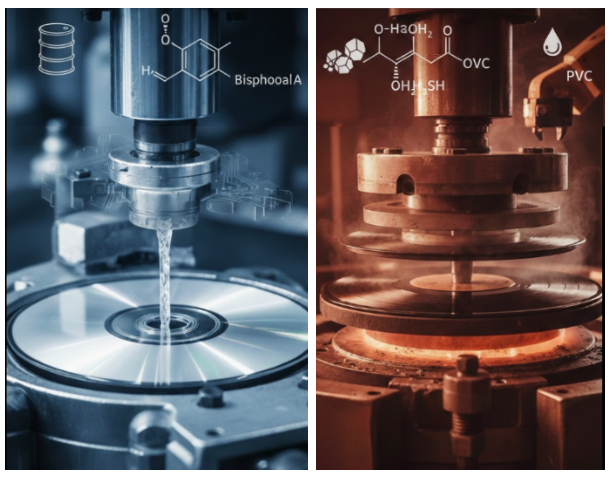 Manufacturing CDs and Vinyl Records: Materials, Pollutants and Environmental Impact ComparedRead more
Discover how CDs and vinyl records are manufactured, the materials and pollutants involved, and their environmental...
-
 This article looks back at a special creation for Arkose Massy, a bouldering gym located in Essonne. An upcycled artwork created from a repurposed CD, hand-painted, and gifted to the venue that inspired it. From the initial grip to the final gesture, everything matters.Read more
This article looks back at a special creation for Arkose Massy, a bouldering gym located in Essonne. An upcycled...
-
 Reusing CDs and Vinyl Records: A Sustainable Alternative to Incineration in FranceRead more
When CDs and vinyl records are incinerated in France, another path is possible: artistic reuse. Discover how I...
-
 To be reborn once againRead more
A special Christmas commission reborn as an upcycled artwork. Discover it in our YouTube video.
Blog categories
Search in blog
Archived posts
Blog Art Upcycling – Création responsable & art recyclé
Bienvenue sur le blog de LD Upcycling Art, un espace dédié à l’exploration de l’art upcycling contemporain, à la création responsable et à la transformation poétique de supports recyclés comme les CD, DVD et vinyles.
Découvrez des articles sur mon processus créatif, l’intégration de l’art recyclé dans votre décoration intérieure et ma vision d’un art durable et engagé.
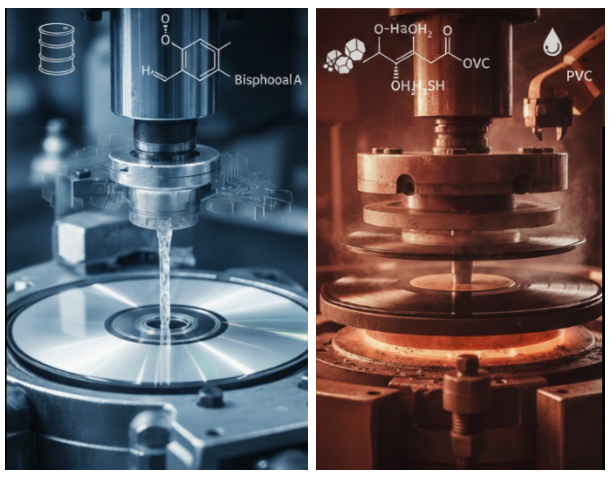
Manufacturing CDs and Vinyl Records: Materials, Pollutants and Environmental Impact Compared
Manufacturing CDs and Vinyl Records: Materials, Pollutants and Environmental Impact Compared
Introduction — Behind the Cultural Object, an Industrial Reality
CDs and vinyl records have shaped the history of music. They have carried voices, preserved memories and accompanied entire generations. They are emotional, cultural objects — almost intimate.
Yet behind this emotional dimension lies a material reality: these formats are products of the petrochemical industry. Their manufacturing requires fossil resources, energy-intensive processes and complex chemical treatments, generating environmental emissions.
At a time when ecological transition has become essential, understanding how CDs and vinyl records are produced helps reveal their true environmental footprint.
This article provides an in-depth analysis of:
-
CD composition
-
Vinyl manufacturing processes
-
Associated pollutants
-
Environmental comparison
-
End-of-life challenges
-
The alternative of artistic reuse
1. How Are CDs Manufactured?
1.1 The Materials Used in a CD
A Compact Disc is primarily composed of:
-
Polycarbonate (approx. 98%)
-
A thin aluminium layer
-
Protective lacquer
-
Printed inks
Polycarbonate: A Petroleum-Based Plastic
Polycarbonate is a synthetic polymer derived from petrochemical compounds, notably bisphenol A (BPA).
Its production involves:
-
Crude oil extraction
-
Refining
-
High-temperature chemical synthesis
-
Transformation into plastic pellets
This process is energy-intensive and produces CO₂ emissions at multiple stages.
Although a CD weighs only around 15 grams, it remains entirely dependent on fossil energy.
1.2 The Industrial Production Process
CD manufacturing includes several stages:
1️⃣ Injection moulding
Plastic pellets are heated to approximately 300°C and injected into a mould containing a master stamper.
2️⃣ Data pressing
Digital information is imprinted as microscopic pits.
3️⃣ Metallisation
A thin aluminium layer is applied via vacuum deposition.
4️⃣ Lacquering
A protective coating seals the metallic layer.
5️⃣ Printing
Industrial inks and screen printing finalise the surface.
6️⃣ Packaging
Plastic jewel case (often polystyrene), paper booklet, shrink wrap.
Each stage requires:
-
Electricity
-
Industrial water
-
Solvents
-
International logistics
2. How Are Vinyl Records Manufactured?
2.1 The Main Material: PVC
Vinyl records are made from PVC (polyvinyl chloride).
PVC is derived from:
-
Chlorine (extracted from salt)
-
Ethylene (derived from petroleum)
It is considered one of the most environmentally controversial plastics.
Why?
Its production involves:
-
Stabilising additives
-
Plasticisers
-
Pigments
-
Lubricants
Historically, some of these substances have raised toxicity concerns.
2.2 The Pressing Process
Vinyl manufacturing is mechanical and thermal.
Main steps:
1️⃣ Creation of a metal stamper
2️⃣ Heating PVC pellets
3️⃣ Hydraulic pressing at high temperature
4️⃣ Cooling
5️⃣ Trimming
6️⃣ Insertion into cardboard sleeves (often combined with plastic wrap)
A vinyl record weighs approximately 120 to 180 grams — significantly heavier than a CD.
This implies:
-
More raw material
-
Higher transport emissions
-
Greater carbon footprint per unit
3. Environmental Comparison: CD vs Vinyl
3.1 Resource Extraction
Both formats depend on fossil resources.
-
CD → Polycarbonate (petroleum)
-
Vinyl → PVC (petroleum + chlorine)
Vinyl requires more material per unit.
3.2 Energy Consumption
Vinyl production is generally more energy-intensive due to:
-
Thermal pressing
-
Greater material mass
-
Heavier transport logistics
CD production requires chemical processes but uses less raw material overall.
3.3 Potential Toxicity
PVC poses more environmental concerns:
-
Production may release chlorinated compounds
-
Incineration can emit harmful gases
Polycarbonate also raises environmental questions, particularly related to BPA.
3.4 End-of-Life Issues
Both formats share a major issue:
? They are rarely recycled.
In many countries, including France, there is no dedicated recycling stream for CDs or vinyl records.
Material separation (plastic, aluminium, inks, additives) is complex and economically unviable.
As a result, most discs are incinerated.
This leads to:
-
CO₂ emissions
-
Permanent loss of material
-
Resource waste
4. Recycling vs Reuse
Recycling involves:
-
Destroying the material
-
Chemical reprocessing
-
Additional energy consumption
Reuse involves:
-
Preserving the existing material
-
Avoiding industrial transformation
-
Extending the object’s lifespan
From an ecological perspective, reuse is often more sustainable than recycling.
5. Artistic Reuse as a Sustainable Alternative
This is where my work takes place.
I collect:
-
CDs destined for incineration
-
Vinyl records considered obsolete
Instead of chemically transforming them, I artistically transform them.
The support remains intact.
Its function changes.
It becomes:
-
A unique artwork
-
A decorative object
-
A symbolic surface
-
A fragment of visible memory
A cultural waste item becomes a surface of expression.
6. Rethinking Our Perspective
CDs and vinyl records are not simple waste.
They represent:
-
An era
-
An industry
-
A measurable environmental footprint
In this context, artistic reuse becomes an ecological and creative act.
It does not deny the original impact.
It extends its meaning.
In a world saturated by production, choosing to transform what already exists is both an environmental and artistic gesture.
ë Explore My Upcycled Creations
You may also discover:
- My recycled CD artworks
- My 33 rpm and 45 rpm vinyl creations
- My vision of contemporary upcycling art
Posted in:
Reuse of musical media
Related posts
-
Reusing CDs and Vinyl Records: A Sustainable Alternative to Incineration in France
When CDs and vinyl records are incinerated in France, another path is possible: artistic reuse. Discover how I...Read more
Leave a comment